KAZA: Beyond Broad Trends
Pinpointing KAZA's Most Vulnerable Rangelands.
November 6, 2025
Rewild Capital. with REHerd Africa
In our previous article, we explored how bush encroachment threatens African rangelands across the KAZA region. Now we turn to a critical question: where should restoration efforts focus first?
The map below shows trends in grass cover between 2013 and 2023 highlighting areas (yellow to red) where grass cover has declined and where there have been gains in grass cover (green).
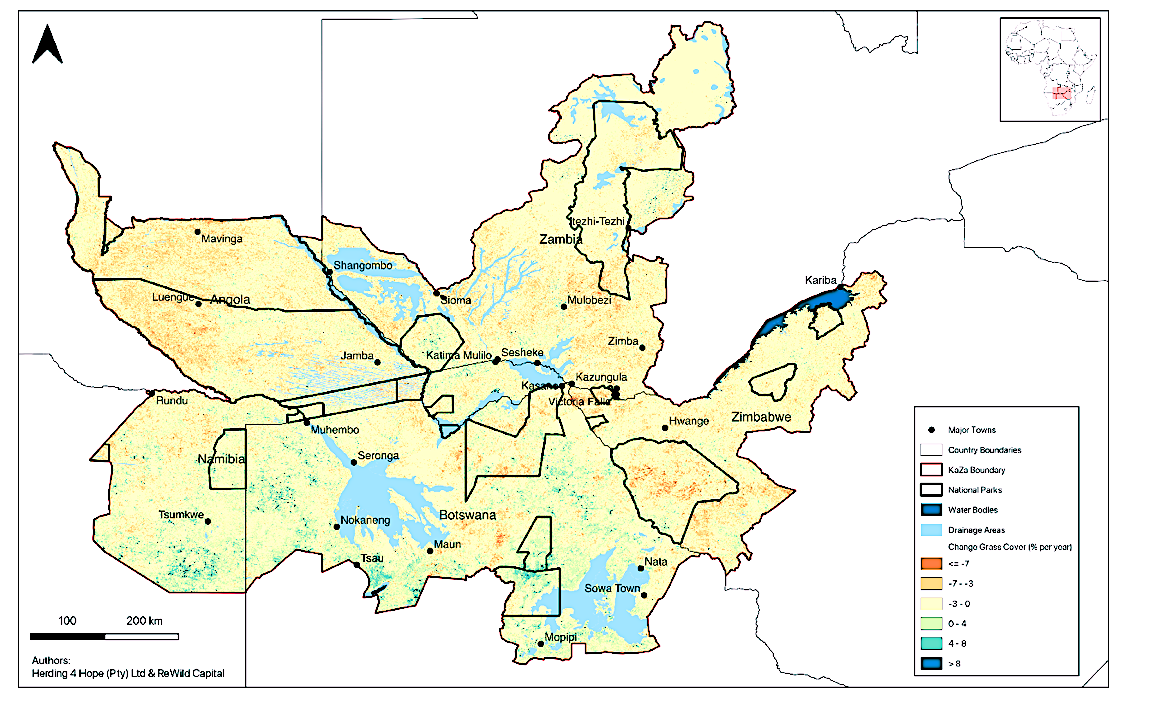
Grass cover, with a mean trend of -0.67% per annum shows significant decline across much of the region with most areas experiencing significant negative trends in grass cover (see summary below). Large areas with declining grass cover are interspersed with smaller patches of improvement, highlighting the grasslands' vulnerability to various pressures (climate change, overgrazing, fire suppression or too frequent fires, agricultural expansion).
From regional patterns to local landscape prioritisation
We can use these datasets to find propriety landscapes for ecosystem restoration. For 17 assessed landscapes within the KAZA region, average grass fractional cover is 36%, with one as low as 17%, which indicates low current grass cover extent for savannas. Assessing the ratio of grassy to woody cover trends allows us to quickly identify which landscapes are healthier and which require targeted interventions. Landscapes with positive rates of grass cover are considered healthy, whereas those with declining grass trends and increasing woody trends may be losing grazing capacity and biodiversity. As the summary below shows, only 3 landscapes have positive grassy trends and all landscapes show positive trends for woody expansion. Most landscapes experience higher grassy loss are also experiencing higher woody gains. These data show that, in collaboration with local stakeholders and context-specific development plans and conservation goals, we could prioritise the six landscapes exhibiting annual grassy cover losses of >1%.

Why Does This Matter?
Identifying discrete landscapes with deteriorating ecosystem indicators enables us to optimise restoration interventions and improve local communities' livelihoods by increasing ecosystem service provisioning. Rather than applying blanket approaches across vast regions, targeted restoration in high-priority landscapes maximises impact where it is needed most.
As discussed in the previous article, bush-thinning financed by biochar production, adaptive grazing, and fire management can restore grazing capacity, enhance biodiversity, and build resilient livelihoods—all while sequestering carbon in soil.
The data now tell us exactly where to start.